
Yaar, Not Another Tech Summit
And then BCAS proved me completely wrong

I walked into the BCAS Tech Summit 2026 carrying a specific kind of exhaustion.
Not physical. The mental kind that builds up when every conference, every dinner, every WhatsApp forward is telling you the same thing — AI will change everything, you are already behind, the robots are coming for your articles, and if you are not prompting ChatGPT before your morning chai you are basically obsolete.
Two years of that. Non-stop.
So when BCAS announced a Tech Summit, my first instinct was — yaar, not again. Another room full of people telling me to use AI tools I will never open after the conference.
I was wrong.
What BCAS did quietly — and I think this deserves more credit than it will get — is remind an entire room of practicing CAs that tech is not just AI. It is security. It is data privacy. It is how you build a practice that does not collapse when the founder steps out. It is how you charge what you are worth to a client sitting in New York or Singapore. And somewhere inside all of that, yes, it is also AI.
I left without paralysis. That alone made it worth the two days.
Let me start with the thing that made the room uncomfortable.
CA. Dinesh Tejwani and CA. Anil Bhandari opened with an idea that has been quietly bothering me for years but which I had not fully articulated. The old hierarchy — article, associate, senior, manager, director, partner — is not just changing. It is inverting. The youngster who knows which tool to use and gets the work done in two hours is now more valuable per rupee than the senior who takes two days doing it the old way. Expertise still matters at the top. But the middle — the comfortable, safe, always-been-there middle — is the most exposed layer in a CA firm today.
We do not need an army. We need sharp shooters.
I say this as someone who has built a team of sixty-plus people. The honest question I am sitting with after this session is: am I promoting the right people? It is easier to reward the person who has been around than the person who is sharp. I have done it. Most of us have. But if you are not asking that question in your own firm right now, someone else — a younger, leaner firm — is already answering it for you.
The session that made me shift in my seat was CA. R Vittal Raj on cybersecurity.
Zero Trust Architecture. CCTV cameras as hacker entry points. Factory resets that do not actually delete your data. All important. But the story that stopped the room came not from the slides — it came from the discussion.
An article used a director’s digital signature to upload a resignation on MCA21. Auto-approved. The director had legally, officially resigned — without knowing it.
Ek second ke liye socho. Your DSC. Right now. Where is it?
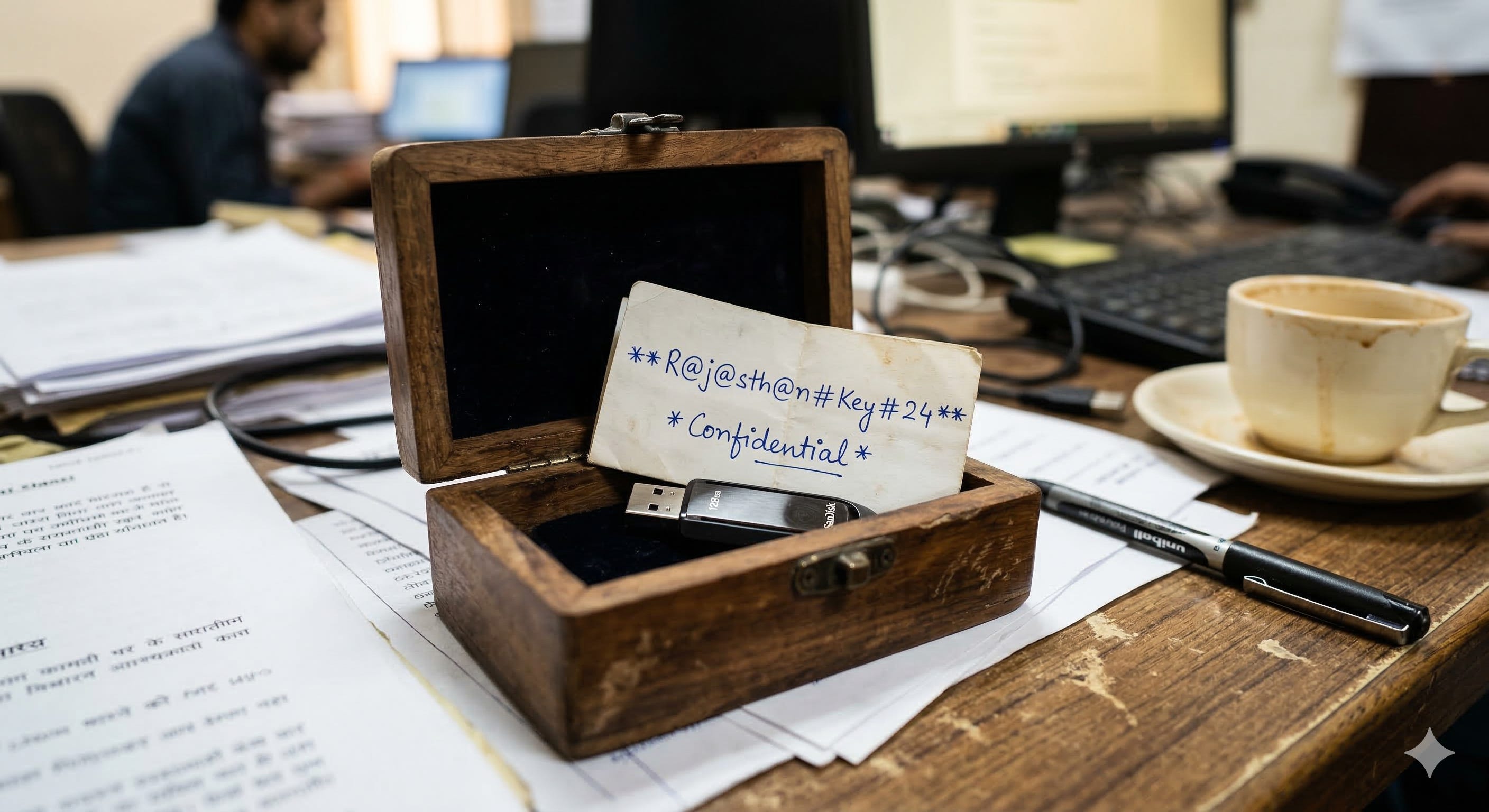
I will tell you where ours was. In a box. Password written on a piece of paper inside the same box. Not carelessness — just the reality of a busy practice where three things are always on fire. CA. Vittal Raj said the DSC should be kept like jewellery in a vault. He is absolutely right. Most of us are keeping it like a spare pen in a drawer. That is not a cultural problem. That is a system design failure.
And it just got expensive. CA. Narasimhan Elangovan’s session on the DPDP Act made clear that CA firms are now Data Fiduciaries — with penalties going up to ₹250 crore for data breaches. The Aadhaar data sitting in your client folders carries specific restrictions under the Aadhaar Act that most of us have not read properly. His practical suggestion: gamify your SOPs. Make data protection something your articles want to learn, not a compliance lecture they survive every quarter.
The box with the password inside it is no longer just embarrassing. It is a liability with a number attached.
Here is something I want to say and mean it.
We criticise ICAI a lot. Sometimes fairly, sometimes out of habit. But CA. Dayaniwas Sharma’s session on the ICAI Digital Maturity Model — DCMM — reminded me that there is a lot happening inside that institution that most of us simply do not know about.
DCMM is a self-assessment framework. It does not tell you where you should be in some ideal world — it asks honestly where you are right now. When I went through it during a peer review, two specific gaps came up at JSCO: no structured training calendar, and IT policies that were not clearly documented. Not a crisis. Just two things I could act on, this month, without a consultant or a committee.
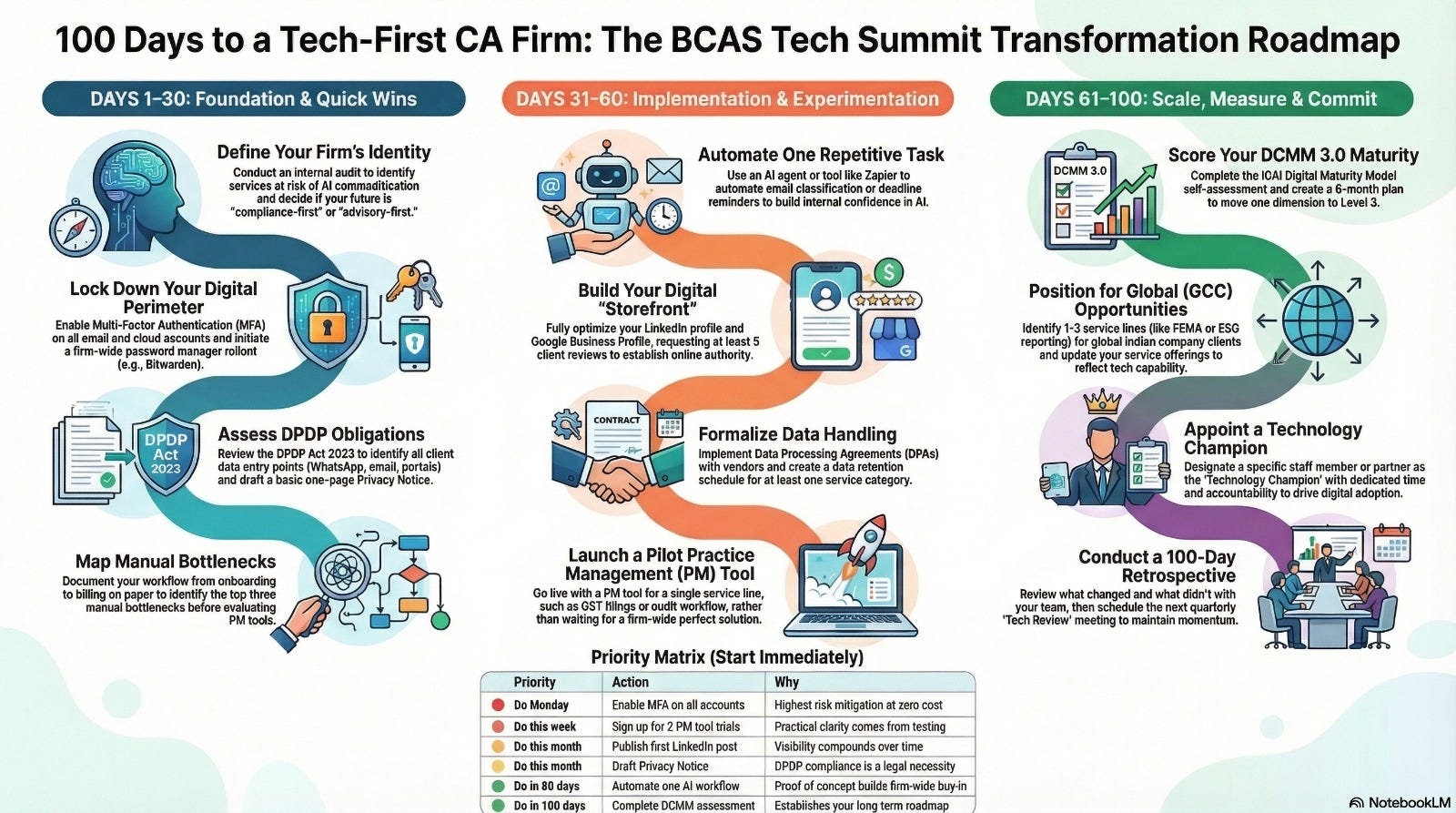
That is also the spirit of the 100-day plan that was presented by Tech committee who organised the summit — which I am sharing separately as a snapshot. Pick one thing from your own assessment. Start there. Build the habit before you build the system.
CA. Sharma also mentioned a new DISA+ course being launched — specifically for CAs who want to audit emerging technologies like AI and IoT. ICAI is not just reacting to where the profession has been. It is, quietly, building for where it is going.
Sometimes the right thing to do is simply notice when your own institution gets it right.
CA. Karthikeya Shenoy’s live demonstration of AI agents — the vision of one partner working with twelve agents, cutting routine time by 40% using tools like n8n.io and running AI models locally on LM Studio so client data never leaves your machine — made the room go quiet for a bit. Everyone was leaning forward. This was not a PowerPoint about AI. This was AI, running, live, in front of 120 CAs.
It was also, for most of us, not where we start tomorrow morning. And that is fine. One thing at a time.
I missed one session — and I am mentioning it precisely because of that.
The fireside chat Government Vision Meets CA Reality — Digital India 2030, featuring Ms. Sanjali Dias, Joint Commissioner of GST, and Mr. Satish Srivastav, Senior Vice President at GSTN, moderated by CA. Ameet Patel, carried a message worth noting: the government is actively simplifying GST compliance through better data flows and system integration. The complexity we navigate today is not permanent.
Its a clear cut direction - Our role as CAs is shifting — from managing compliance friction to adding value above it.
The fireside chat between CA. Druman Patel and Mr. Karthick Venkatakrishnan — moderated by CA. Nitin Shingala — was about India’s GCC moment. The shift from back-office outsourcing to something bigger: Indian CA firms as genuine global partners. One structural point stood out — engagement contracts with global clients can be written so that liability is capped at fees charged and jurisdiction stays in India. That is not just legal protection. That is a framework for competing globally without betting the firm.
When we recently engaged with a US client, they asked us to carry a professional indemnity insurance of $3,000 before the engagement could begin. Not because they doubted our work. Because they needed visible proof of how we had built the firm. That insurance — and everything it represented about our systems, our documentation, our seriousness — is what made the premium fee possible.
This is exactly what CA. Rahul Bajaj was pointing at in his session on Practice Management Systems — build your firm like a product, not a service. And what CA. Shraddha Dedhia was pointing at in her session on digital branding — stop using LinkedIn as a resume and start using it to show how you think. Two different sessions, same underlying argument: when you invest in visible infrastructure, you are not just cleaning up your operations. You are making the case, silently, for why a sophisticated client should pay you more than the firm down the road.
Tech is not just about operations, When rightly portrayed it can determine your price point.
Most of us have not made that connection yet.
Two days. Five sessions each day that really mattered. One specific list of things to fix at JSCO.
Thank you to BCAS for building a conference that gave us handles, not just highlights. And to every speaker who brought something real into the room.
Now if you will excuse me, I have a DSC to move into a vault.
And a training calendar to build.