
Timesheet: Love. Hate. Repeat.

I hate timesheets.
I also think they’re the most important tool I’m not using correctly.
Both are true. At the same time. And that contradiction has been living rent-free in my head for twenty years.
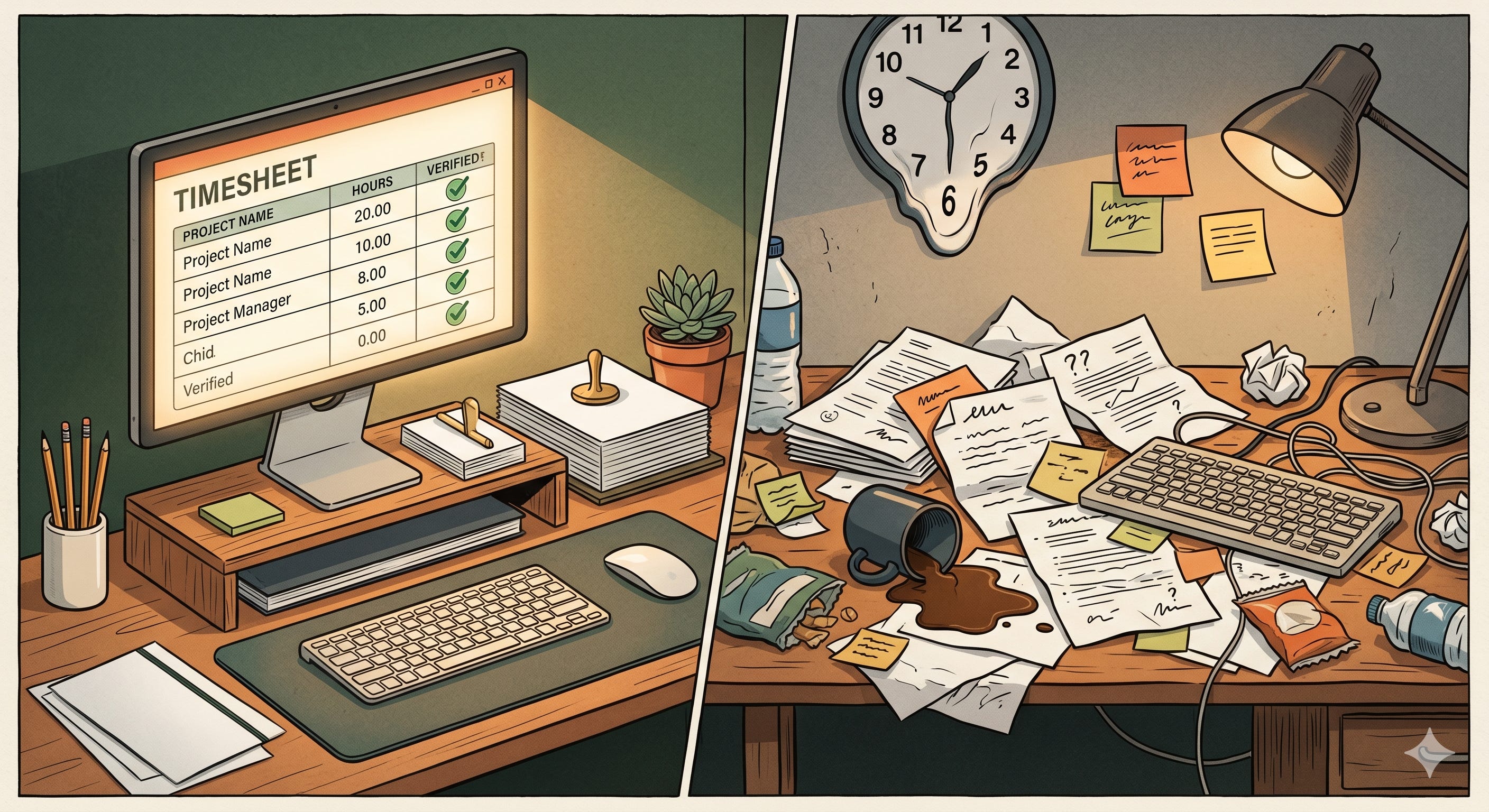
Some weeks I’m convinced — measure everything, track everything, know exactly who is doing what and when and how long. Other weeks I think — yaar, this is a CA firm, not a factory. We’re not assembling cars. Why am I counting hours like a 1920s mill owner?
And then something happens. And I’m back to square one.
2015-16. I implemented a task management software. Big, hyped, everyone was talking about it. I was the first in Rajasthan. First. I was so proud of that. The guy who moves fast, thinks ahead, figures it out before everyone else.
It failed. Publicly. Badly.
Not because the software was wrong. Because I was wrong. I thought technology would fix a system I hadn’t built yet. It doesn’t work that way. IT amplifies what exists. I had nothing. So it amplified nothing.
Threw it out. Told myself — kya farak parta hai. People will work. Good people always work. Trust them.
And they did. Mostly.
But the ones who didn’t? They figured out the game very quickly. Show up at the right moments. Look busy when it counts. And I — flying completely blind — couldn’t tell the difference fast enough. Good people left. Quietly. No drama. Just gone.
That stung. Still does.

Tried again a few years later. Simpler tool. More realistic expectations. Failed again. Different reasons, same result.
And now I’m trying a third time. Right now. While writing this. My team doesn’t know yet. I haven’t shown them anything. I’m still building it, still second-guessing it, still not sure if I’m about to solve something or repeat the same mistake with better software.
This is not a success story. I don’t have one. Not on this topic.
What I have is this nagging feeling that won’t go away — that the biggest problem in my firm, and probably yours, is not the clients. Not the regulations. Not even the fees.
It’s that we are not paying attention to our most important asset.
Our people.
In a CA firm — any knowledge firm — people are the business. The thinking, the judgment, the relationships, the output. All of it lives inside human beings who show up every morning and leave every evening. That’s it. That’s your entire balance sheet walking out of the door at 7 PM.
And most of us — hand on heart — are managing that asset on gut feel and WhatsApp messages.
AI has made this worse. Or maybe it’s made it more visible. I can’t decide.
Recently at JSCO — someone senior, going nowhere, wasting good prompts, producing nothing useful. Someone junior, article level, delivering something a partner would be proud of. Same tool. Same access. Completely different outcomes.
I almost missed it.
That’s the problem. Not the timesheet. Not the software. The fact that without some form of measurement, I am flying blind over the most expensive, most important thing I have.
A timesheet won’t tell me who my best person is. My instinct does that. My conversations do that. But a timesheet? It will tell me who my worst performer is. Objectively. Without politics. Without the noise of who sends messages at midnight to look dedicated.
That’s not a small thing. In a firm like mine, that’s everything.
But here’s where I get stuck. Every time.
We are not HR experts. I am not an HR expert. I know international tax. I know transfer pricing. I do not know — not formally, not systematically — how to monitor, utilise, and report on human performance in a way that is fair, consistent, and actually useful.
And the honest truth? Most SME CA firm owners don’t either. We just don’t say it out loud.
We track every rupee of client billing. We have files for everything. But our people data? Somewhere in our head. In a vague annual conversation where everyone gets a decent rating because nobody wants that awkward December discussion.
That’s not a performance system. That’s just hope with a spreadsheet.
I don’t know how this third attempt ends. Maybe I’ll finally crack it. Maybe I’ll write a follow-up blog six months from now about failing for the third time. Both are equally possible, honestly.
But I know this much — the question of how to measure people in a world where a junior with one good prompt outthinks a senior with ten years of habit — that question is not going away. It’s getting harder. And those of us who figure it out, even imperfectly, will build something that actually lasts.
Are you measuring your most important resource?
Are you monitoring them, utilising them, reporting on them — to yourself, at least, if nobody else?
Or are you also just hoping?
I’m still figuring it out.
Maybe that’s enough to start.
Very well articulated Naman. However, after filling my timesheets for almost last 15 years I can tell you one thing, timesheets are not only to reflect who is doing what and for how long but to efficiently manage resource fungibility, to analysis how much we are spending in terms of time cost on a client and whether that time cost substantiate the fees from that client or should we require to charge overruns from that client. Moreover, timesheets also helps in manoeuvring high performing resources on a demanding projects, etc.